Wednesday, April 21, 2010

Our honey bees


I've been meaning to add a few things to this blog since I stopped in 2007 ... I even have a few draft posts out there (the trip to Mexico eight months ago, for instance) but have just never made the time to finish them. Perhaps it is not very evident, but I really don't make a good blogger. Not that I'm going to start back up, but I might TRY to post some stuff a little more frequently. This seems like a good location for longer tales, and our little honey bee saga several weekends ago is definitely a longer tale that I wanted to write down somewhere, so here we go.

First things first: last May we started noticing some honey bees hanging out around a hole in our house toward the roof above our back door. The hole APPEARS to have been for an exterior light since there is a box in it, but I took a look when we first bought the house, and I could find no wires to the box. Back in the day when I was up on that ladder and realized there were no wires and that I wasn't going to put in a light immediately, I should have probably covered the hole. Hmmmm. But I didn't. So, over the course of the summer, there were more and more bees. Hundreds of bees in fact. They were very docile and we could very easily go in and out the back door, even hang out directly below their new home, without any aggression.

The number of bees flying around this hole grew quickly over the summer and we began thinking about the fact that eventually we would need to get the bees OUT of the house. An initial concern was rot that could be caused by honey in the wall; however, in reality, as long as the bees were alive, they would maintain the honey and there would likely be no issues. Another issue was, oh, the now thousands of bees flying around above the door. Not a giant worry, but not exactly ideal either. We called a couple of beekeepers in August/September and they were very flaky: one scheduled some time to come out and never showed and the other simply never called us back. I realized later that this was because right before winter is NOT a good time to take over a hive of bees. The bees have established a good honey supply over the spring and summer and would most likely die if moved directly before winter.

The other facet to this story is that I was very interested in keeping the bees myself in the corner of our yard for pollination of our garden and, of course, for honey. Plus walking around the yard in a beekeeping outfit would just look bad-ass. I knew that the start of spring would probably be the best time to relocate the bees, so I took a beekeeping class at a local bee supply store in December and began chatting up our friends Todd and Jess since they kept bees when they lived in California. Along comes March of this year, and I still didn't have much in the way of "plans". Feeling a bit intimidated, I asked Todd and Jess if they would be interested in helping remove the bees from our house to a hive box and then we could share the hive and the honey. They have a new child as well and were feeling a little overwhelmed by the idea of keeping bees right now, but Jess did a bunch of research on the ways to get the bees OUT of the house, and they lent me all the parts to a hive box that they had in their basement with the idea that I would buy it from them if the bee relocation worked out (thanks again guys!).

Then the bees "swarmed" twice in one week. Swarming typically happens when a colony splits and the queen and a bunch of workers take off looking for better, less crowded digs. The swarm was essentially thousands of bees flying around our back door and over in our neighbor's yard. Our neighbor knew about the bees and was hip to the idea of me keeping them, but she still went running into her house. We decided we needed to do something soon. I talked with Jess and Todd again, then called the bee supply store where I took my class so I could run our removal ideas past them. We were hoping to put a mesh funnel on the hole outside the house (which would allow the bees out but would confuse them coming back in) and then put the hive box near the hole for them to move into. The woman at the bee supply store essentially said that if we didn't cut the wall and remove the honeycomb and the queen, our plan was pure folly. And cutting the wall would involve thousands of angry bees. And it would be best to cut from the outside of the house if you weren't prepared for the thousand angry bees to be INSIDE the house.

I decided this needed to be done by someone with some experience. I went back to the Oregon Beekeepers page and called a beekeeper, John, who agreed to come out and assess the situation. He was very laid back about the whole affair and said that he and his father-in-law would cut the bees out of the wall (from the inside) and he would even tie the honeycomb into the frames in my hive box, all for $100 or $150 (he was pretty relaxed about pricing as well ... I paid him $150). Typically honeybee removals involve a decent fee AND the beekeeper takes the bees with him/her, so this was a pretty good deal.

The following Saturday morning John, his father-in-law Byron and two of his daughters (both around 10 years old and pretty knowledgeable about bees) showed up at 7:45 for the operation. The night before I had put a piece of cardboard and a bunch of duct tape over the entrance so that none of the bees would be out foraging when we started the removal. The plan was to cut into the wallboard in our mud room between the kitchen and the basement, so we closed and taped off the kitchen door and hung some plastic in the door to the basement to keep most of the bees out of there.

We then suited up and Byron began cutting the wall with me standing by watching (and taking pictures). These guys had a special kind of vacuum that doesn't injure the bees significantly and dumps them into a box that can then be detached and emptied into a hive. Pretty cool contraption. The operation went very smoothly ... Byron cut the wall little by little and sucked up bees with the vacuum. As he cut, the extent of the honeycombs became more apparent. These buggers had built eight three-foot tall honeycombs between two studs above our back door.


There were bees everywhere and we could also see a couple of queen cells (where queens larva were being raised) as well as a bunch of drone and worker bee cells. Once the majority of the bees were removed, Byron started carefully cutting out the honeycomb and passing it out to John who would then tie the comb into hive frames using twine.


Honey dripped profusely. When all of the bees and honeycomb were removed from between the two studs, Byron noticed a couple of bees crawling from a small crack that led into the region between the next two studs to the right, so he cut the wallboard there as well. He found several hundred more bees, but fortunately no honeycomb. After the vacuuming operation had completed, John took the bee vacuum box back to my new hive in the back corner of our yard, dumped the mound of bees into the hive box and closed the lid (the picture below is after most of them had settled down into the frames). John estimated that there were around 8000 to 10,000 bees living in our wall.


The whole procedure was done by 10:30; Byron got stung once on the wrist and I got stung once on the leg ... pretty good.

John and his crew gave me a few parting words of wisdom before leaving. First, he said that he could not find a queen amongst the bees he dumped into my hive. He suggested I wait a week or two to see if any of the queen cells hatched, but it might be a good idea to go to the bee supply store and buy a queen for good measure. He also said that some of the bees would make their way back to the entrance to the old hive and that I should periodically spray them with sugar water, use a bee brush to brush them into a bag and then carry them back to the hive. Lastly, he said that once the bees got used to their new home, they wouldn't need much attention for quite a while, possibly most of the summer.

As the day progressed, I would suit up occasionally and go out back to see how everything was going. Here and there I went in the back door with a dust buster and vacuumed up the straggler bees that I found. There were quite a few stragglers crawling around, and I found a few in the basement that had gotten around the plastic. At one point I had my first (and possibly only) experience carrying a load of laundry around the house, stain treating a couple of items and starting the wash clothed in a bee veil and bee gloves.

By early afternoon, the ball of bees outside huddled around the old (duct taped) entrance had grown and it seemed like a good time to perform my first beekeeper duty of escorting these lost souls back to their new home. I made some sugar water in a spray bottle, grabbed a ladder, bee brush and paper shopping bag and headed out back. Climbing a ladder to arrive face-to-face with a ball of confused, possibly angry bees is a wonderful experience that everyone should have at least once in their lifetime. I sprayed the sugar water (which is meant to make their wings sticky and sort of pacify them), and this only seemed to confuse them. I learned later that the sugar/water concentration is supposed to be about 50/50 ... mine was more like 5/95. Positioning the stupid bag underneath the bees was entertaining ... it had previously been folded and just wanted to refold, not realizing how important it was to me that it stayed open. Once the bag was adjusted and positioned appropriately, I took the bee brush and brushed the bees toward the bag. Rather than a lump of bees falling gracefully into the bag and me casually closing the bag and walking back to the hive, here's what happened: the bees fell toward the bag, exploded into a cloud, and surrounded me. Trying my best to maintain my cool, I yelled, jumped off the ladder, ran like hell to the hive with the damn bag WIDE OPEN, threw the bag at the hive and began to furiously clean the bees off of me with the bee brush. I don't believe any of my neighbors witnessed this, but man, it had to have been funny to see. I came away from this experience with adrenaline pumping like mad, but not a single sting. Woo hoo.

Later, I went out back and there was another good sized ball of bees on the house. Thinking that being surrounded by a cloud of bees was just something I was going to have to get used to, I positioned the ladder again and headed up to perform my duties. I guess I figured that my issue previously was in the USE of the bee brush, not, say, in my 5 part to 95 part sugar water solution. This time I was going to do it right. Sadly, the EXACT same thing happened again, complete with me screaming and running across the yard. This time I did get stung.

Sam had been planning to go with a friend to a swap of some sort and then on to a movie. The next couple of events happened quickly and were slightly surreal. First, Sam left, I went back to check the laundry and realized that there were still quite a few "stragglers" in the house. Strange. Hazel woke up from her nap. I started to be able to hear the bees through the kitchen door into the mud room. I went around back and noticed that the bees had actually worked the duct tape off of the entrance hole (weak tape? wet?)!! From outside, the window in our mud room was covered with bees ON THE INSIDE!! I called John but he didn't answer. I felt fairly anxious because I now realized the bees were all coming back in the house, and I couldn't really do a thing about it at home alone with Hazel. Argggghhhh!!


So, the day continued on. The ball outside the house got smaller and smaller and the number of bees visible inside the house grew. I could easily hear a steady drone of bees when I went over to the kitchen door into the mud room. I decided that the best thing I could do was reenforce the taping so the bees would be quarantined in the mud room and the basement. Unfortunately, the duct tape was in the room with the bees and didn't seem to work so well anyway. I went next door to our neighbor Rey's, borrowed some packing tape and double/triple taped around the kitchen door. Then I hunkered down in an old rocking chair facing said door with a shotgun across my lap, fighting sleep and waiting for something to happen (my descent into horror movie comparisons begins).

Our friends Bill and Stef came over for dinner and we discussed the deadly peril just a couple feet from where we were eating, held at bay by a couple layers of packing tape. It was dark outside and while doing the dishes, I started hearing a muted buzzing, looked over and saw several bees along the tape at the bottom of the door wiggling like mad trying to get at human flesh. Stef mentioned that they were attracted to the light, and this gave me an idea. I suited up, went to the garage and lit a gas lantern. I then made my way to the back door, carefully opened it and extended the lantern inside.

The scene that confronted me was creepy as all hell. First of all, the room was very warm, almost humid. Believe it or not, bees actually poop: it shows up as long brown streaks (which is all over the back of our house) and smells like cat urine. The room I was leaning into smelled of cat piss, honeycomb and honey. If I could bottle this smell and sent it to all of you, I would. There were a few bees buzzing around here and there. The floor was littered with hive pieces and bee corpses ... stepping into the room, bees crunched under my feet. But most terrifying was the pulsing mass of bees attached to one of the shelves in the mud room. The mass was larger than a football. There was also a smaller mass by the window.

So, my thought was "hey, these bees seem interested in light, why don't I give them a big lantern, leave the door open, they'll flock towards it and I'll close the door behind them". But the bees didn't seem very interested in the light. I then decided that they might need to be "awakened". I took a handful of pebbles from our back yard and tossed them at the mass. Nothing. I then decided that I would try to knock them off their roost, thinking then they would possibly take interest in the lantern. No big sticks anywhere, a broom would be fantastic for the task at hand. Looking back into the mud room, I saw the broom at the top of the stairs, leaning against the wall ... mere inches from the mass of bees!! Very, very carefully, I stepped into the mud room and made my way up the stairs, trying not to step on any live bees. (Apparently when bees are squashed, they give off a pheromone that attracts other bees to the spot). Reaching, reaching. I managed to get the broom, slowly back down the stairs, position myself in ready-to-run mode in the back door ... then I reached in with the broom, swatted the mass off the wall and ran like mad up front, leaving the back door open. About a half hour later I suited back up and went out back to check on the situation. I was thinking there might be a little bit of mass pandemonium around the lantern, but quite the contrary: there were only one or two bees there. Picking up the lantern and peeking back inside, I saw the mass of bees was simply lying on the ground, right where I had swatted them to.

So, here's how the story ends. I could barely go to sleep that night, anxious that bees were going to get into the house sometime in the night or early morning (by the way, I can sleep sitting up on a bus). At 8:00 in the morning, I headed downstairs and found that, thankfully, no bees had made it through our packing tape defenses. Seconds later, John called. He said that he had worried that something like this might happen. (Was this a beekeeper's trial by fire?) When a beekeeper wants to move a hive of bees from one side of the yard to another, he/she first should move the hive about five miles down the road, wait a week or two, then move it back to the desired location. Bees establish flight patterns and it can be very hard for them to change when they detect familiar landmarks. Attempting to place a hive in the back of our yard only confused the bees. John revealed that he KNEW all of this, but that I seemed so excited about keeping the bees that he had just decided to see how everything went.

John and his gang arrived about an hour later, he suited up and went in to re-vacuum the bees. At one point he stepped outside and asked his daughter to check that there were no openings in his bee gear because the bees were very "ornery". I imagine having your home demolished in front of you, being sucked into a giant vacuum and then dumped unceremoniously into a new, smaller apartment with most of your furnishings cut in half, going back to the bare earth where your old home once stood, camping out there, remembering good times, perhaps singing all night, then come daybreak being sucked into a giant vacuum AGAIN could be frustrating. My bees left with John that morning, and I got up on a ladder and nailed a piece of wood across the old entrance.

There were still some bees to be dust busted out of the house, most in the mud room but a couple in the basement as well. A ball of determined bees began forming outside of the entrance, but not nearly as large as the ones I bee-brushed. Over the course of two days, the little ball seemed to be sliding down the wall, then one day it was gone. No dead bees lying around, just gone. I still have Jess and Todd's hive box in the garage, there's a good sized hole above our back door and, believe it or not, I still am contemplating buying some bees.

Wednesday, December 19, 2007

Goodbye Ifrane!

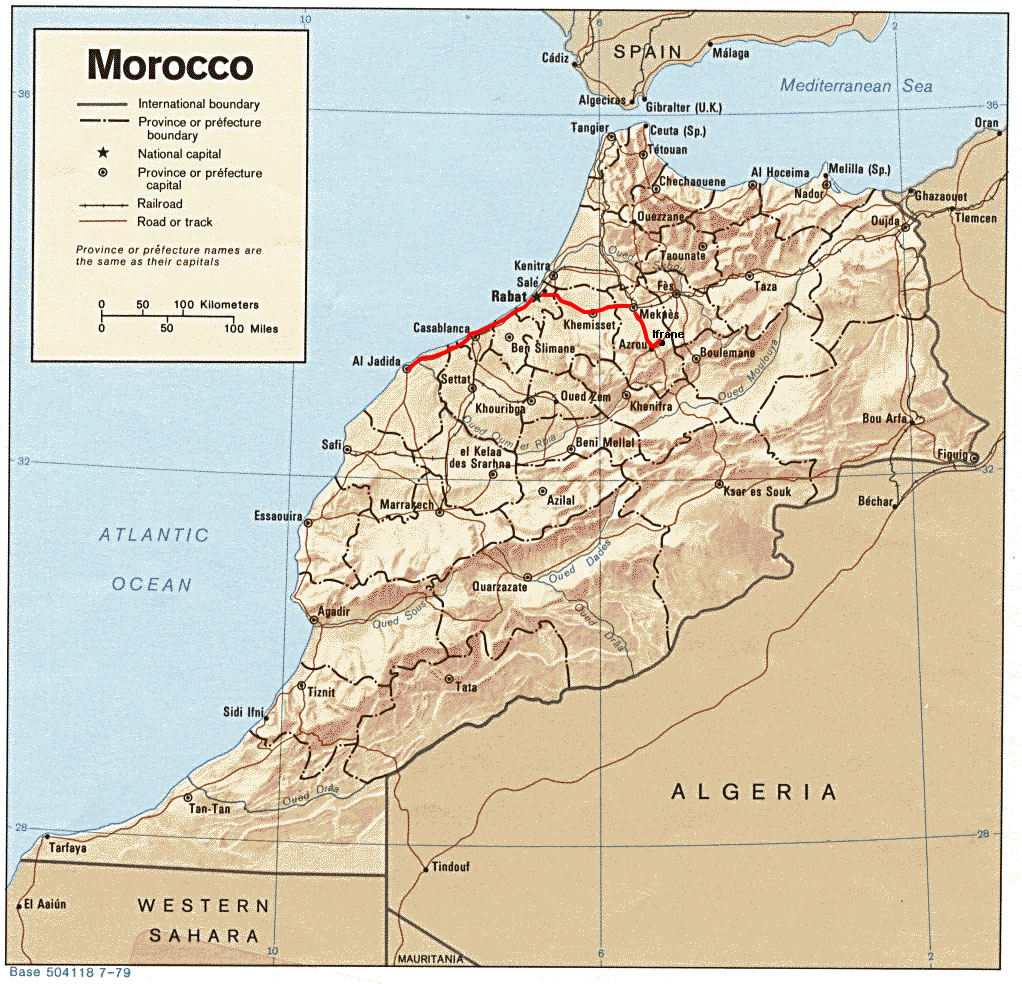
One final Morocco posting: we have made the journey from Ifrane back to lovely Portland, Oregon! The trip was pretty uneventful ... we took off from Casablanca at 1:30 a.m. Sunday morning (Moroccan time) had a four hour layover in Frankfurt where we partook of our first swine in quite a while, then it was a direct 10 1/2 hour flight to Portland. Rachel and Ryan met us at the airport and helped lug our plethora of bags (thanks SO much guys!): two large backpacks, two small carry-on backpacks, two medium roller bags, one large rolling garment bag, my guitar, a cloth bag with my laptop and a plastic bag with some miscellaneous stuff purchased in Morocco!! We had to pay to check an extra bag in Casablanca and carried a couple of extra things on the plane - no one stopped us, so I assume it wasn't a big deal. Once reunited with part of our Portland posse, the four of us immediately proceeded to La Bonita for some burritos (YUM!) and to a coffee shop next door for some Stumptown (double YUM!!) and conversation. We are now chilling at Rachel's new, incredibly cute house in North Portland and trying to figure what happens from here.

(The weather here is slightly cooler and slightly wetter) --------------->


To rewind just a bit: the last week in Ifrane was very nice - the weather was really warm, and we had a few dinners with people to sort of say goodbye. Thursday and Friday nights we had people over and got rid of a bunch of the stuff we had acquired over our stay. Unfortunately, the tagine wouldn't fit into our luggage, and I'm guessing if we HAD fit it, it would have been powder by the time we got home, so we gifted it to Katie. I couldn't part with the stove top espresso maker and managed to jam it into the top of my backpack. I had an excellent latte yesterday that would not have been possible if I had left this beautiful device behind.

The travel day prior to our flight was actually really cool. We have a tendency to be rushing around on big days like this, but amazingly that didn't happen this time around. Our packing was pretty much done Friday night. We hired a van from AUI to take the two of us, plus Katie, Misty and two other people (Carla and Katie II) to a hotel in Casablanca at noon on Saturday. This gave us plenty of time in the morning to shower, do some final packing and eat a good breakfast before setting out. The van ride was a little vomitous, as are most automobile rides in Morocco, but we made it in one piece to Casa and it was great to have some time to chat. We reached the Hotel Ibis in Casa (where Katie and Misty were staying for a night or two before their flights) at about 5:30 p.m. and essentially had 6 hours to hang out. There was a little bit of bullshit about putting our bags in their room ... I think the management was concerned about the morality of one man going to a room with four women. This was a really classy joint, you see. We managed to work around it, though the folks were none too friendly.

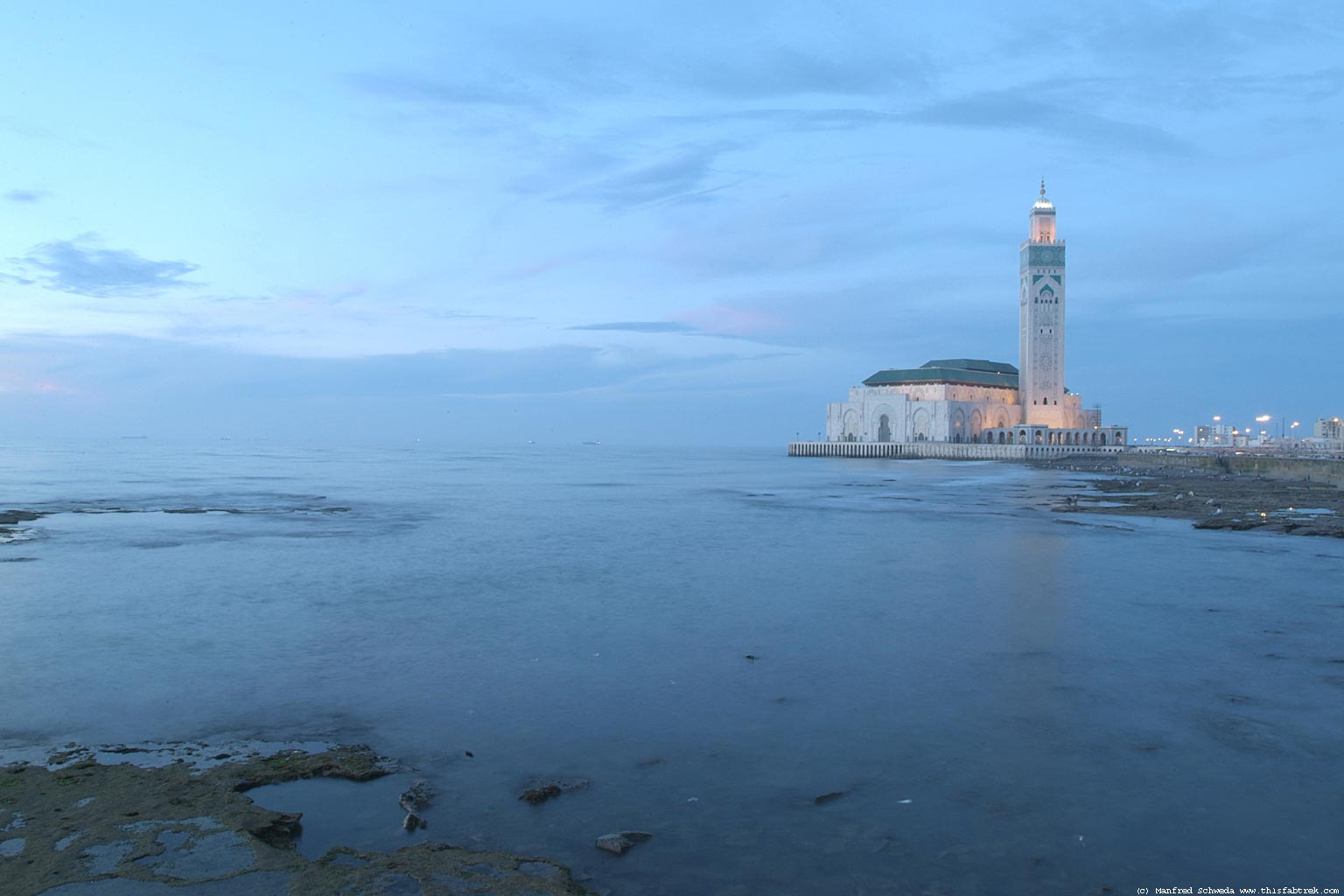
Our six hours in Casa were spent chilling with coffees on the Ibis patio, visiting the giant Hassan II Mosque (second largest in the world), and grabbing some delicious Italian food. I didn't bring the camera to the mosque since it was back in the room and management didn't want me to go, but Misty and Carla took some pictures, so hopefully I can get ahold of them soon and put them up for y'all. It really was an amazing thing to see and pictures probably won't do it much justice. We had all visited MANY mosques in Morocco and were surprised at how friggin cool this thing was. It's situated right on the ocean. There are only special hours when non-Muslims can enter, so we didn't get to go in, but apparently a portion of the prayer room has a glass floor where you can look over the rocks and waves below. The minaret is gigantic, with brilliant zellij mosaic at the top (and supposedly a laser pointed toward Mecca, though we couldn't see it). Leading up to the mosque is a wide open plaza with carved arches along the sides. As we walked up, the call to prayer was announced over the speaker - it was very loud and pretty surreal to hear it echo all around us. Once up to the mosque, the artistry was utterly amazing. Some 6000 local artisans worked on the wood, marble, steel and zellij found around the structure. The doors into the mosque were made of steel and had to have been around 60 feet tall! Hopefully some pictures will be available soon for you ... here's one I found on the net: Hassan II Mosque.

Goodbyes were a little sad, though at least we'd had quite a bit of time to hang out over the day. They were hurried a bit by the process of getting a grand taxi to take us the half hour to the airport outside of Casa. The minute we stepped out of the hotel with our baggage, a grand taxi driver approached and said his price and porters appeared from nowhere and bags were being grabbed and loaded and no, we would need two grand taxis since we had so much luggage and it would be dangerous (HAH, you gave yourself away grand taxi driver ... you learned the word "dangerous" from tourists) and Carla just kept saying no, we're only taking one taxi and kept cramming stuff in the car then Sam wedged herself in the back seat and we had to force the door closed and Carla and I sat nearly on top of each other in the front seat and oh yeah, bye Misty and Katie, and we were careening away from the hotel. But, we got to the airport early enough to deal with stuff and only had one worrisome moment at the gate when agitated passengers three gates down started pounding on the walls and yelling and pulled the fire alarm. We had our final kahwa nous-nous (half espresso, half milk) from the Casablanca airport cafe, and damnit, I forgot to take a picture.

Pictures: Goodbye Ifrane!

Stories from Ali

On our trip to Chefchaouen (and Rabat) with Ali and Denise, we heard several stories about Morocco that I thought were really interesting. Ali is a fantastic story teller; he's really good-natured and has an awesome sense of humor, so it's hard not to get totally wrapped up in the tales he's telling. Unfortunately, I only remember a few, but I guess it's a little bizarre re-telling someone else's stories anyway, so I'll just summarize a couple:

* Ali's brother-in-law (let's call him Fred, since I can't remember his name) is fairly wealthy; he makes his living as an artisan and does wood carving and marquetry. At some point his work was "discovered" by someone important, and since then he has done ceilings and such for other important someones. So, at some point many years ago Ali was visiting Fred's villa in Rabat and noticed that the front facade of the place was beat up and incomplete, whereas the interior was immaculate and richly decorated. Ali was thinking that this was to keep beggars from coming to the house, but he asked Fred anyway. Apparently back in the day when dignitaries were visiting from other nations, the king and his posse would politely "ask" the owners of nice villas to leave for some amount of time so that these dignitaries could stay there. Any servants had to stay on at the villa. No compensation was provided and the place would be in whatever condition the dignitary decided to leave it. Thus, Fred left the front of his house looking awful to avoid the attention of villa-grabbers. (We also heard about a tax loop hole where incomplete buildings were not taxed, hence the number of occupied buildings with sparse facades and exposed rebar throughout the country.)

* We stayed with Ali's nephew, Yousef (Fred's son) on the coast in Rabat. Ali does not seem too concerned with directions ... he simply heads somewhere and then stops and asks people as he drives by where he needs to go. This was the same situation when we arrived in Rabat Sunday evening. Though Ali has been to Yousef's house several times, he really doesn't know how to get there. He gets to the outskirts of town and then calls Yousef and tells him what he is seeing. Several calls to Yousef were made. At no point did Ali stop the car, we just continued driving and turning and getting more lost, then calling Yousef and saying "there's a restaurant, ok now Cafe Dijana, something like that, lots of people." And suddenly a car flies past us, pulls in ahead of us and flashes its brake lights: Yousef has gotten in his car and SOMEHOW found us through Ali's convoluted description of where we were. I was amazed, and told Yousef this before we were even formally introduced. I also hypothesized that perhaps this was an elaborate training scheme concocted by Ali to turn his nephew into a CIA operative.

* There were a myriad of stories involving Ali and Yousef's relationship, since Yousef lived with Ali in San Francisco for several years back in the day. One prominent aspect of Moroccan life (and life in any country, really) is that who you know is incredibly important. Favors are granted incessantly and friends call upon friends, relatives and acquaintances to help out all of the time. "My friend is the mayor of Meknes, so I'll see if he can help out with some funding." So, to bring this back to Yousef and Ali: Ali's wife Denise was traveling in Rwanda this fall and made this arduous journey with some contacts she knew there into the jungle to see some mountain gorillas. I don't remember the specifics, but she essentially found she had no money and couldn't get any money easily. Somehow she got ahold of Ali. Even though Ali lives in the States, he is still Moroccan, so apparently he is not allowed to send money via Western Union ... Moroccans are not allowed to take money out of the country (he also has to carry a marriage license with him to be able to stay with Denise in hotels in Morocco). Ali got ahold of Yousef to see if he could contact friends of his in Europe and have them wire some money to Denise. Yousef was drunk when he received the call and only understood something about Denise being in the jungle, something about gorillas/guerillas and something about her needing money. So, he started calling people trying to figure out how he could get a helicopter in to Rwanda to help Denise out. I'm sure this has happened to half of y'all reading, so I'm conveying this story only so that you can nod knowingly. Remember that time you tried to get Uncle Billy out of Cambodia by hiring ninjas from Japan ... ?

* Ali wistfully told us about how young goats are the best pets ever. He said that his father would give him a baby goat to take care of when he was a kid (hee hee). The goat would follow him everywhere and would hang out with him just like a dog. As the goat got older, it wasn't quite as friendly. Eventually the time would come to slaughter the goat, and Ali would plead with his Dad, so they worked out a deal. They would take the goat to the market where his Dad would "sell" it, then they'd bring a new baby goat home for Ali.

Wednesday, December 12, 2007

More Morocco Miscellanea

(I re-posted with a picture of people hanging out in one of the main traffic circles in Ifrane.)

* An interesting tidbit that Sam and I noticed in the first month we were here is the habit Moroccans have of walking in the street. Sidewalks are only a suggested path. Traffic circles are particularly fun ... the trick is to simply walk into the circle toward the middle pretending you are a very slow moving car, follow the circle to the road you need and wander slowly across traffic. In the bigger cities, there are occasionally cross walks; however, the traffic lights are typically placed so that they are impossible to see (even if you're driving) and the little pedestrian lights never work. So, the approach taken here is similar to the traffic circle: walk confidently into traffic, utilizing the space between lanes for safety, do not falter. If you hesitate or look startled, that's when you'll get an irritated horn from a driver, but if you just walk directly in front of them without hesitating, that's business as usual.

I've heard people suggest that this has to do with the fatalist nature of Moroccan culture. The phrase "enshah allah" (God willing) is uttered after nearly any statement of future intent. Most of the time, this is to show deference to a force higher than oneself, but sometimes I think it can be translated as "if something better doesn't come up" as when someone says "I'll meet you at the cafe at 3:00 tomorrow, enshah allah". Soooo, if I step into fast moving traffic without even looking, everything will be just fine ... enshah allah. I prefer to apply the theory I have about the stop-sign-lacking neighborhoods in Portland. I think the purpose of these areas is to force drivers to be more aware of their surroundings. In neighborhoods WITH stop signs, drivers often learn their locations and then drive very fast, almost automatically, on the stop-less stretches. Removing the stop signs makes these drivers slow down at every intersection and check for traffic. By walking in the streets, Moroccan pedestrians are forcing drivers to pay close attention to their surroundings and vice versa, essentially raising awareness of day-to-day dangers. (However, you can wipe the tears that this beautiful tale of pedestrian/driver symbiosis surely induced ... I still would bet that more pedestrians get hit by cars per capita here than in the States.)

* When one buys eggs at the marche, he/she can be fairly certain that they were laid within the last few days. Eggs are cheap, are set out on the counter at several shops and disappear fairly quickly. In the States, Sam and I make an attempt to buy food in bulk to reduce the packaging, but this may be one instance where some packaging would be appreciated. The store owners simply place however many eggs you ask for in a plastic bag and tie it off (we bought eggs in bulk in Corvallis, but there was a big pile of egg cartons nearby). Only once or twice have I made it home from the marche without a cracked egg or two.

* Many of the past posts have referenced the joys and horrors of getting in a grand taxi or petit taxi here. The lack of seat belts is troubling, but the extreme tail gating is downright terrifying. What's the rule? One car length for every 10 mph? We've been in grand taxis going at least 60 mph and nearly touching the giant truck in front of us that is impossible to see around. A tap of the brakes would be problematic. There are "rules" of the road, but a lot of the time they are ignored if there aren't police around. And there are rarely police around.

Much like other aspects of Moroccan culture, those who assert themselves the most are the winners. For instance, if you're in a line at the store, it's a good idea to get right up against the counter or someone will slip in in front of you and yell their order. (I should be fair: this is not unique to Morocco. The US, Canada, England and Germany are experts at queuing, but this concept is not held in as high of regard in other countries, Italy being nearly as bad as Morocco.) The rules of the road mimic the lines in a store: if you want to get into traffic, you just go. Get your nose out there so people can't get around it, and if you stop traffic, so be it. As mentioned above, in the cities there are pedestrians blindly diving into the street, bikers and sheep are often present, so it is actually more like an obstacle course. Always interesting. A driving video game should be made with different roads in Morocco as the scenarios. Beginner: the route from the marche to Al Akhawayn in downtown Ifrane; Intermediate: the road from Ifrane to the outskirts of Meknes; Advanced: downtown Meknes/Fez/Rabat, all with a bag of eggs on the passenger seat.

* In the first couple of weeks we were here, Misty, Sam and I met a guy named Hicham at a restaurant downtown. He was waiting tables there and spoke Spanish pretty well, so he was one of the first Moroccans outside of the university that we could have a reasonable conversation with. At some point, he expressed interest in working on his English, so he and I started meeting twice a week for a few hours at a cafe downtown. The idea was to drink several coffees and conversate in English, and I could give him pointers on conjugation and usage. I've never taught English so I may have done more harm than good. And three quarters of the time we just spoke Spanish since it was much easier. But it still was entertaining.

Since these classes started, Hicham has been asking us to come to his family's house for dinner. So, Monday night we finally took him up on the offer. Samantha, Misty and I met Hicham on the main road and walked with him to his home. We got to meet his mother, father and brother and trade as much Arabic as we could muster. They were all really friendly, and though there were a few silent moments, we actually had some pretty fun conversations, with Hicham staying very busy translating between Spanish and Arabic. The US geography lesson drawn on a napkin was particularly compelling. Hicham's mom also showed us some djellabas and rugs she'd made years ago ... the djellaba that Hicham's dad wears when it's cold was made of wool, took two months to make and he has worn it for fourteen years!


The dinner started off with mint tea, served in the Moroccan style by Hicham's father. After that came Moroccan salad (tomatoes, onions, peppers, vinegar), beef tagine with prunes and a huge plate of couscous with chicken and vegetables. Everything was communal ... there is a formal washing of hands prior to eating, then everyone digs into his/her section of the large serving dish. Bread can be used to pick up food or to clean one's fingers of sauce. The food was EXCELLENT: the tagine was definitely one of the best I've had in Morocco and the couscous was far better than the world famous couscous served at Al Akhawayn every Friday.

* I got a hair cut at the marche a few days ago. It's quite the experience having someone approach you holding wildly snapping shears, with only a thin wall of French vocab to protect you. Sam says I look like 1950's George Harrison. I told the guy I wanted to look like a cross between Brad Pitt and George Clooney, but with Johnny Depp's eyes ... guess something was lost in translation.

* Oranges and tangerines are in season ... I paid 7 dirham (90 cents) for 2 pounds yesterday!!! Also starting to show up at the market are quince and huge gourds.

Monday, December 10, 2007

Chefchaouen

We hung out in Ifrane this past weekend ... our last weekend here!! The weather was gorgeous and sunny. There have been maybe ten to twenty days of clouds and (hard-core) rain since we've been here, but other than that, the sky has been amazingly clear. It gets a bit chilly at night and we've had one morning with a hint of snow on the ground, but Sam and I never need to turn on our heat. We've hypothesized that we get all of the heat from the three floors below us, but it just isn't all that cold. We actually crack our window at night because it's too warm.

But I'm off track: not a lot to report about the weekend past. Took a really nice walk in the hills by Ifrane, had a coffee downtown, and watched some laptop movies on Saturday (Oceans 13, Stardust). Sunday, we headed to Azrou in the morning to hunt down some souvenirs, then came back to Al Akhawayn for a Christmas concert ... not necessarily our bag, but there were choirs from sub-Saharan Africa there to spice things up a bit. It was a pretty cool experience, though it started late and ended very late. We ended up having dinner with our friend Julia downtown around 9:00. Very late dinners, also not our bag.

I need to rewind a little more. TWO weekends ago, we took a pretty awesome trip to a town called Chefchaouen about five hours north of here in the Rif Mountains and about 30 minutes from the Mediterranean. Sam and I were planning on going by public transit (1 hour grand taxi to Fez, four hour CTM bus ride through the mountains to Chefchaouen). However, our friend Ali and his wife Denise (visiting) were over for dinner on Thursday, and said they were heading to Chefchaouen the next day as well. So, Sam canceled her class and ducked out of work early, and we jetted in Ali's car. Ali is Moroccan-American; he's around 55, was born in Morocco and moved to San Francisco when he was 30. He speaks Darija, French and English perfectly. That said, this trip was quite different than the other trips we've taken here since Ali could always communicate with anyone we bumped into, and he understands all of the little cultural nuances as well.

Chefchaouen is a beautiful town; I would definitely recommend it to anyone planning to visit Morocco. The word "chaouen" means "peaks" and "cheef" means "look", thus the name references the two enormous Rif peaks looming above the town. The Andalusian Moors fleeing Spain settled in Chefchaouen (and other areas in northern Morocco), so the medina has the Andalusian-style blue and white paint, much like the kasbah in Rabat. Also, Spanish is more common in the north than French, which, as with Barcelona, was a refreshing change. Another fun fact about Chefchaouen and the surrounding area: marijuana and hash (kif) are the main cash crops here. I read somewhere recently that the term "reefer" is actually a reference to the Rif Mountains. Interestingly, I was offered hash no less than ten times, whereas Sam, Ali and Denise received only one or two offers. Perhaps it was the mullet?

We spent quite a bit of time wandering the Chefchaouen medina ... really a nice place, and little to no hassle. Had some pretty damn tasty food as well (lamb tagine with prunes, pastilla). Perhaps one of the coolest aspects of the trip, however, was the easy access to some good hikes. We took a short hike on Saturday to a ruined mosque high above the city (great views), and on Sunday we made our way to a village called Akchour and hiked about an hour or so to a rock formation called God's Bridge. On the drive, Ali would stop every so often and ask people where the hell Akchour was ... eventually he ended up picking up this man on the side of the road who had come from Tetuan (40 miles away) and was going to visit his friend. This dude decided to not visit his friend and to be our guide for the hike instead. He was wearing a djellaba (a long robe), some worn out sneakers and a stocking cap, he looked like he was aroun 60 or so, had very few teeth ... and he flew up this steep trail like a mountain goat. At one point I took off running, he laughed and chased right behind me. God's Bridge was pretty spectacular, and it was made even more spectacular by the guy who had set up a pseudo-food stand to one side (everything cooked on a wood fire), made us some tea and even cooked me an omelet. We didn't end up eating for several hours afterward, so I was very glad for this omelet.

The trip home was pretty entertaining as well. As with our earlier trip to Marrakech, Ali's persuasive abilities were put into play. He needed to get Denise to the airport in Casablanca for a flight early Monday morning. His plan: drive to Rabat, stay with his nephew there, get up VERY early and drive to Ifrane. Sam and I were PLANNING to take the bus/grand taxi combo back to Ifrane from Chefchaouen, but just never got out of the car. Ali kept suggesting we come along to Rabat, and we were driving through some nice countryside, AND we drove through one town where we could catch the train, and it was seeeedy. So, after five or six hours, we were in Rabat hanging out at this swass restaurant on the ocean. Lots of wine and excellent food consumed. We slept on the couch at Ali's nephew's place, a fairly swass place as well right on the beach, and were up at 4:30 a.m. (yuck!) to drive to Ifrane. No matter how much this early morning sucked, Sam and I agreed this took the place of Marrakech as the coolest trip we took in Morocco. Here be some pictures: Chefchaouen.

Monday, December 3, 2007

Return to Rabat + El Jadida

Falling behind ...

(Some good news: After condensing my thesis from 75 to 30 pages, redoing many of the figures and going through several editing cycles with my adviser, I finally submitted the manuscript to Landscape and Urban Planning on Friday. Now I just have to wait for reviewer comments and pray I can respond to them!)

Two weekends ago I decided to take a long weekend and head to a town called El Jadida south of Casablanca on the coast. Misty was going to Rabat for the weekend with some friends of hers, and Julia was talking about driving to Rabat on Saturday to listen to a band play at a bar there, so the plan was that Sam and I would head to Rabat either on the train or in Julia's car, hang out on Saturday in Rabat, then I would take off Sunday morning on my own down the coast. However, Saturday morning we still hadn't managed to get ahold of Julia (we were getting a message in French on our phone that we were sure was a problem with her phone, but it turned out we were out of credit), Sam decided she didn't really want to deal with public transit to Rabat, so I jumped on the 9:00 bus to Rabat by myself Saturday morning.

(Nothing is heated here, including busses. If you go for a coffee, the people serving you are wearing scarves and hats. The bus was shivering cold until we got down to the valley.) The bus took an exceptionally long time to get to Rabat, for some reason passing through Azrou, which is not normally on the route. Hmmm. I got to Rabat, caught a petit taxi to the city center, got a hotel room, then received a call from Sam saying she and Julia were on the outskirts of Rabat and wanted to meet for lunch!! (I guess I wouldn't be able to relay that little tidbit about heating on busses if I had ridden comfortably with Julia and Sam rather than on the bus, right?) Lebanese food, crepes and several coffees were consumed with zeal. We even had some mediocre Thai food for dinner ... none of the food at this restaurant was great, but the place was really nice and the wine went down well. Sam and Julia headed back to Ifrane around 10:30 p.m.

Sunday morning I hit one of the major sights in Rabat, Le Tour Hassan (
The Hassan Tower) before catching the train to El Jadida. The tower is a minaret that was intended to be the largest in the world back in 1200 AD or so, but then the sultan having it built died and the tower was never completed. The thing is still bloody huge. It stands right next to the ruins of a huge mosque that was destroyed in an earthquake back in the day and is now just a great plaza of columns. Opposite Le Tour Hassan across the ruins is the mausoleum of King Mohammad V, the grandfather of the current king. Non-Muslims were actually allowed to enter the mausoleum, which is rare in Morocco ... there was a brilliant coffin in the middle of a room ornately decorated in zellij and wood, and in the corner was a man singing from the Koran.

I got to El Jadida within a few hours of catching my train, caught a petit taxi downtown and grabbed a hotel room one block off the beach. Sort of a bizarre place ... there was a "restaurant" downstairs with a huge door that was closed all day long. When I first arrived, I poked my head in because I thought it was the entrance to the hotel, and everyone stopped and stared at me, old-west-saloon style. My hair is getting sort of unruly, so maybe they'd never seen the starts of a mullet before. The hallway upstairs was pretty dark, and there was a button you could push to turn on a light. However, the button was a little hard to find in the dark, and when one pushed said button, it made a huge cracking sound when the lights came on. Not sure what was going on there. Probably the most worrisome thing about the place was when I went downstairs around 7:00 a.m. Monday morning and found myself locked in with no one around to open the door. I went upstairs and pushed the light button a couple of times hoping the "crack" would locate the owner for me. I think he was showering, and he showed up fairly quickly, but still a little weird.

The strangeness of my hotel aside, El-Jadida was a really good time. I made my way to the Cite Portugaise (Portuguese city) and wandered around the ramparts for a while. The city was the main Moroccan trading center for the Portuguese, and the gate to the ocean is still there, though it was now a backdrop for a vicious game of football. In the center of the city were stairs leading down into the surreal Portuguese cistern underneath the city. Really cool, and apparently used by Orson Welles in his version of Othello. Grabbed some seafood at a roof top terrace (the first fish I've had in months ... not a lot of fish in Ifrane), had some really good ice cream (the first good ice cream I've had in months as well), then hung out on the beach until late. The moon was full and the tide was way out so the beach was huge, and I'm pretty sure I could see the lights of Casablanca up the coast. The beach seemed to be populated primarily by necking Moroccans. Perhaps the anonymity of darkness made these youts feel a little less apprehensive about showing affection in public? It felt a little like hanging out under the boardwalk alone. If Sam had been there, we definitely would have necked.

My plot was to take off on the 8:30 a.m. train, but sitting at a beach side cafe watching the sun rise and drinking some excellent coffees made me dally. I ended up walking the beach, exploring the tide pools and BARELY catching the 10:30 train to Meknes. I decided to jump off the train in Rabat for a couple of hours to grab some more Lebanese food (lunch AND take out for dinner) and visit the ancient necropolis of Chellah, a burial ground built on top of Roman ruins. Pretty nice setting for a falafel sandwich. Got to Meknes in the early evening, enjoyed one of the most terrifying petit taxi rides I've had here, then waited for a good half hour for a grand taxi to Ifrane to fill up, even though I bought two seats to speed the process. My love and I were reunited and there was much rejoicing.

Pictures here: Rabat II and El Jadida.

Tuesday, November 27, 2007

Morocco Miscellanea

Some random goings-on and Morocco observations:

* Apparently no one in Morocco got the memo about Thanksgiving, because everyone had to work. However, we did an evening dinner with our neighbor Katie, which was appropriately gut-busting AND entertaining to boot. There were ten or eleven people. Sam and I were in charge of sweet potatoes ... I could find nothing that looked like sweet potatoes at the marche, so I asked one of the guys if "he knew of a potato with the flavor of sugar". He got excited, nodded and said to come back the next day and he'd have two kilos for me. I came back the next day, and he had a bag of sweet potatoes beneath his counter. Who knows where he found them - they may have been stolen. Our friend Ali (who lives in San Francisco but is from Morocco) was in charge of turkey. He tried to get the turkey a little late from some guy on the road to Azrou, and when the guy showed him the skinny birds he had to offer, Ali got three of them and then had his maid cook them. They looked more like small chickens than turkeys when they arrived (and their bodies were outstretched, not tucked like a cat, as in the States), but what meat there was was really tasty. Hope everyone reading had an awesome holiday!

* The "6th annual Moroccan Film Days" event was held last week from Monday to Wednesday. Each night they screened two shorts and a longer film, and the directors and cast were there for a discussion afterward. Right up Sam's and my alley. E-mail queries to the coordinators of said fete could get no concrete answer as to whether or not the films had English subtitles. So on Wednesday, Sam and I went over to the presentation hall, found some students there who we thought might have something to do with the show, and we asked them. They assured us that there were English subtitles. So, we grabbed some dinner up town, made our way back to campus, plopped down in the theater and waited the obligatory 45 minutes past the published starting time for the films to actually start.

The first film was about a boxer. That's all I can really tell you because the film was in Arabic, the subtitles were in French AND the subtitles only appeared sporadically, even though no French was spoken in the movie. Not that either of us could really have followed French subtitles, but it would have at least given us somewhere to start. There were apparently some funny parts surrounding some blonde lady in red. There was supposed to be another short, but for whatever reason, this was skipped, and we shot directly into the feature film ... all in Arabic, no subtitles. We walked out and headed home. (To make up for this, we got a pirated copy of Superbad and The Lookout online and watched at home).

* Yet another three hour cooking endeavor to report: last week I made some flour tortillas and some chili rellenos, and they were pretty damn good. Never made tortillas before, so they were way too thick ... hard to fold but tasty nontheless. This is the third time I've made chile rellenos, and each of the other times I vowed that I would never make them again. This time, I think I may have finally gotten it right (though I'm still not sure I'll take the time again). There is a plethora of traditional Moroccan fare in the Ifrane restaurants, but we can't find a chile relleno burrito anywhere.

* Water has a very central role in Moroccan culture. Each medina has a series of elaborately decorated fountains (pictured) which at one time were the source of water for the city's inhabitants and where people still fill water bottles. A rule that we were told is that if someone asks for water, it is considered rude to deny the request (he told us this when suggesting we keep our Nalgenes inside our backpacks). Water is scarce and precious, especially toward the desert, and is considered a shared resource. Some consequences: there is often one glass cup in bathrooms that everyone uses to drink water (uhh, nasty). Likewise, in most cities one sees colorfully dressed men with bladders of water on their back, serving it in a communal cup from a spigot. Sam and I were eating on the patio of a restaurant in Fes and had a large bottle of water. At one point a group of three girls came by, stopped, came over and asked if they could have some water. We had an empty glass with "napkins" in it on our table (napkins here are ripped up sheets of paper ... quite absorbant), so we were able to adhere to this desert rule. I have also on a few occasions seen people walk into a restaurant, walk to the water jug, pour a glass of water, drink it and walk out.

* Second in importance only to water in Morocco is that sport that most of the world calls football, but we in the US have taken upon ourselves to call soccer. Why we had to call American football "football" and call what the rest of the world knows as football "soccer" must have stemmed from the same juvenile decision to be different that caused the multi-holed shaker to be salt in the US, but pepper in England. Or that resulted in England and its historical colonies driving on the opposite side of the car AND of the road as the States. How often do the foot and ball actually interact in "American" football? As much as in "The Rest of the World" football? Maybe there's something more to it, but I refuse to Wikipedia it. Any which way, everywhere we go here, there are people playing football. They create a goal from any two objects they can find (shoes, bricks, mounds of sand) and play all day long. Almost every day and every where we've traveled here, we've seen at least one game of football being played. On a trip to El Jadida on the coast this past weekend (more on this in a later post), there were kids playing inside the ramparts of the old Portuguese fort (with one goal up against the gate leading out to the ocean), just outside the ramparts (pictured) and at multiple places on the beach until fairly late at night (the beach was lit).

Thursday, November 22, 2007

The Cedar Gouraud, Barbary apes and Azrou

As mentioned in the last posting, two weekends ago we postponed our day hike in the nearby cedar forest and opted to go to Volubilis instead. This past weekend, however, worked out much better for the day hike anyway, since the weather was gorgeous, and our friend Julia (who has a car) wanted to go.

The "day hike" became more a of a "day wander". We first made our way to the Cedar Gouraud, a gigantic cedar tree surrounded by trinket shops at the end of a dirt road between Ifrane and Azrou. I have a brochure from the tourist office in Ifrane, which claims that the tree is the oldest Atlantic Cedar in the world. Of course, the brochure is in French, so my translation may be off. And it wouldn't surprise me if this was something the tourist office thought would be cool to put in the brochure, true or not. "Gouraud" is not a French word, but it was the name of a French general, Henri Gouraud, who was stationed in Fez and put in command of all French troops in Western Morocco in 1914 (thanks Wikipedia), so I'm guessing that's how the tree got its name. A little piece of water resources irony: around five years ago, water was diverted in the watershed for agriculture and this pillar of Middle Atlas tourism died. There are many other huge cedars in the area, so someday soon, one of them will replace the Cedar Gouraud as the largest Atlantic Cedar ... and I'm going to do everything I can in our last month here to have that tree named Cedar Shaub.

We didn't focus too much attention on the giant, dead tree, however, because there were monkeys all over the place! They're called "Barbary apes", but they are actually monkeys, a mistake which is accredited to their ape-like lack of a tail. So, picture a visitor to the US who's never seen a squirrel spending multiple hours in Central Park pointing at every squirrel that ran by, laughing, gasping and taking pictures ... that is exactly what we were like to the trinket shop owners. One of these shop owners picked up a rock and menaced some pesky monkeys away that were hanging around his shop. The monkeys are all over in the woods, but some brilliant soul decided it was a good idea to start selling peanuts to feed them, so they now congregate around the trinket shops during the day. And idiots actually buy peanuts and hand them to the monkeys, pretending they are cute, tame house pets, helping them overcome their aversion of humans and kindling a hankering for human food. (I'm picturing the sign at Yellowstone showing a bison goring someone who got too close.) Unfortunately, Sam, Julia and I could not help but join the ranks of such idiots. It must be something in the tap water. (We've heard tales of the zoo in Rabat where people can feed the monkeys AND the bears, lions, etc.) These little buggers would take peanuts from you and one even grabbed ahold of and drank from my water bottle, but they were still pretty skittish and ran off if you moved quickly.

After hanging with the monkeys for a while, we had a picnic on a bench a little ways away from them, and amazingly, not one monkey came and tried to eat our food. However, a couple wild dogs hung around for a while and got the remains of Sam's veggie burger (home made by Julia). At some point, a group of Moroccans materialized at a nearby picnic table, making quite a bit of noise and taking rides on the decorated horses and donkeys that
some locals bring to the area for tourists. Gotta say it was both sad and hilarious to see two grown men being slowly led around on tiny donkeys ... one guy was talking on his phone and nearly got bucked.

Perhaps the coolest part of the outing was the walk we took after lunch. There really weren't any clear trails, so we just walked back in the woods and paid attention to landmarks. At one point, we got to the top of a good sized hill and got a decent panorama of the area, which is really pretty beautiful. As we were heading back, we ran into a large group of monkeys playing around, so we hung out amongst them for a bit. They didn't seem to mind our presence in the slightest, and every so often one would walk over and pull on our pant leg for a peanut. Julia and I both had monkeys climb up us for peanuts we were holding in our hand, which was a bit bizarre. We think that it was monkey mating season, because of the swollen, inflamed rumps of the females, the several territorial fights we saw between the males and the couple of free, XXX peep shows we stumbled upon. But what do we know about monkeys?

Our day was capped with a trip to the nearby Berber village of Azrou. We hit one of the shops there for a little bit so that Julia could buy a hookah, then we grabbed some tea and coffee at a cafe before heading back to Ifrane for dinner. Really a pretty chilled out day ... check out the pictures: Barbary apes.

Wednesday, November 14, 2007

Moulay Idriss and Volubilis

This past weekend we were planning on doing a day hike in the famed Middle Atlas cedar forests around Azrou, about ten minutes south of Ifrane. The hikes are said to be quite beautiful AND there is a good chance of bumping into groups of barbary apes foraging about. Who wouldn't want to see apes foraging? I've been e-mailing a guide in Azrou, but his prices for an overnight trek (staying with "nomads") was a little spendy, so we were considering just wandering for a day on our own. So, since he works for a Guide Association in Azrou and wants to advertise the region, I mailed him again for some dayhike information, and he sent me some details. However, he also recommended we watch out for shepherd dogs ... not sure what that meant, but, coupled with the idea of taking a grand taxi to Azrou and trying to find a trail head, our excitement waned slightly. And our friends Misty and Julia were over for dinner Friday, and Julia recommended we go the next weekend (i.e. tomorrow) IN HER CAR to a cool trail in the forest that SHE'S ALREADY WALKED, so we scrapped our dayhike fantasies.

The plans promptly changed to a trip to the nearby Roman (yes, the ones from Italy) ruins of Volubilis and the pilgrimage town of Moulay Idriss just north of Meknes. Lilting French was put into play to reserve a room in Moulay Idriss, then Sam, Misty and I caught a grand taxi to Meknes. Next was a harrowing twenty minute grand taxi ride to Moulay Idriss and a very confusing search amongst the VERY narrow streets (donkeys and pedestrians only) to find our maison, essentially a house converted to a hotel. We actually ended up asking a young man for help, and he took us on a circuitous path we could never repeat right to the place. The hotel was really cool and tranquil, there was only one other person staying there and the owner was soft-spoken and friendly. We ended up having a tagine dinner that night at an intimate table outside our room, sat and chatted there with mint tea until late, and had breakfast there as well, successfully avoiding too much evening interaction in Manville. (Moulay Idriss is a small town and is thus a little more traditional = lots of men out at night, not many women). Our hotelier was not around when we wanted a coffee, so I walked to a cafe in the center, asked for three coffees and the dude gave me three glasses and a tray and asked me to bring them back when I was done!

Moulay Idriss was a very picturesque town built on a steep hillside and surrounded by mountains. The buildings were white washed and reminded us a bit of the Greek island of Santorini. The town is home to the mausoleum of Moulay Idriss, one of the first great rulers of Morocco. This mausoleum is a holy pilgrimage site, and supposedly five trips here is equal to one haj to Mecca for Muslims. The entrance and courtyard of the mausoleum were visible on our walk uphill to our hotel, but non-Muslims were not allowed past the front gate. I WAS able to get a picture of the green tile roof of the mausoleum by standing precariously on a wall on the roof of our hotel.

Right after we checked into our hotel, we went back to the grand taxi lot and caught a ride to the Volubilis ruins about 4 km down the road. The place was really cool, out in the middle of the gorgeous countryside. Views back to Moulay Idriss were very nice as well. There was a tour group or two when we first got there, but the place was big enough to feel like we had it to ourselves to some degree. That is, except for the shepherds and sheep wandering amongst the ruins ... can you imagine the number of gates and guards around a similar site in Europe or the States? We had a couple of hours to wander and got to see sunset from Volubilis.

Many people who have been to Volubilis from Ifrane get there by renting a grand taxi all the way from Ifrane and then having the driver wait around for them, a fairly costly endeavor, plus you have someone limiting the amount of time you can spend at the site. So, our approach was nice in that we had until closing to hang out. However, we had not arranged transport back to Moulay Idriss and planned on walking if there were no taxis around. There were no taxis or any other type of transport (car, bus, donkey) around when we left after dark. So, we had a nice hour walk back with dusky views of the mountains, punctuated by a couple dives from the road to avoid the insane drivers on the curvy road. But, we made it back safe and sound for our scheduled tagine. Check out the pictures: Moulay Idriss and Volubilis.

Tuesday, November 13, 2007

Our scientifically advanced alarm clock

At some point in the past ten years, I was either given or went and purchased the Oregon Scientific alarm clock pictured to the right. It's a pretty cool contraption in that it converses with satellites and makes sure that the time is always spot on (if this REALLY matters or not is beyond the scope of this post). There is a button on the back that allows the user to change between the four time zones found in the United States.

This picture was taken at 11:08 a.m. When we first arrived, I manually set the clock to Moroccan time, and it was fine for a few days (enough time to re-establish communication with its satellite friends). Then one morning, the alarm didn't go off, and the clock said that it was 4:00 a.m. rather than 8:00 a.m. I searched through an online user guide and did some Google searches, but apparently this clock works as designed only in the US. There is a "Lock" switch on the back that fixes the time and deactivates all of the buttons, but this would be pretty annoying when the alarm is buzzing in the morning and can't be turned off without "unlocking" it.

So, we put the clock in Eastern Standard Time mode, set the alarm for 3:30 a.m. and added four hours to the time whenever we consulted the clock. This approach burned us in Barcelona, since they are actually five hours ahead of EST. We had plans of buying large quantities of tofu, maple syrup, oatmeal and other delicacies that we can't find here, but I set the alarm incorrectly, and we ended up rushing around and grabbing a taxi to the bus station just to make our flight. And just as we were getting used to things, along comes Daylight Savings Time, which is not celebrated in Morocco. Amazingly, two mornings ago I woke up with the feeling that something was off, checked my watch and found out that it was 7:30 even though our alarm clock said 2:30. Crisis averted.

Sunday, November 11, 2007

Green March in Barcelona

Last weekend was Green March holiday in Morocco, which celebrates an historic march in the 70's organized by King Hassan II that resulted in the Spanish relinquishing their colonialist holding of Spanish Sahara in the south of the country. Sam and I celebrated this event by flying to the land of the former oppressor and cavorting for a few days in Barcelona. (A hot piece of local news: Spanish king Juan Carlos caused a national uproar when he visited Melilla and Ceuta, Spanish cities in the north of Morocco, during the Green March holiday. Moroccan ambassadors to Spain were called home.)

Our trip brought no local ire that I've found out about, and it was an incredibly refreshing change for both of us. I can speak and understand Spanish a hundred times better than French, and Sam can understand quite a bit of Spanish as well, so it was nice to be able to communicate effectively for the first time in a while. The phalli growing out of our foreheads must have shrunk due to the climate because the incessant staring stopped. There was a plethora of great food cooked by people from all over the world. And the wine was exceptional and sulfite (headache) free. Paying in euro when earning Moroccan dirhams was a little harsh (take for instance the $55 breakfast we had on Sunday morning), but we did quite a bit of walking around, hit the free admission day to the Picasso museum and ate some pretty cheap noodle bowls and falafel sandwiches.

I recently thought a bit about how some peeps might find it pretty funny that I always detail the modes of transportation used in getting from point A to point B. But, to quote Townes Van Zandt: "Where you've been is good and gone, all you take's the getting there". I always find it interesting to see what it takes to get around a country, and there's an exceptional feeling when you start to understand a country's transportation system to some degree. Plus, sometimes the stories of getting around are ten times crazier than the time at the destination. So, please bear with me.

We hit the marche early Saturday morning and secured ourselves some seats in a grand taxi to Fez. We only had to wait ten minutes or so until the six passenger spots in the car were taken ... four in the back and two (plus the driver) up front. This was the first time we tried out a fully loaded grand taxi, and it wasn't half as bad as we thought it would be. Plus, each seat cost 21 D ($2.50). One thing that we have learned about grand taxi travel is that if you stick to a normal route, the price is fairly fixed, but the minute you ask to be taken somewhere off the route, the bargaining begins and usually starts pretty high. For instance, I talked with a guy at the marche about going to the train station in Meknes, which is a five minute drive from the grand taxi lot, and the price went from the standard 150 D to 300 D, whereas a petit taxi from the grand taxi lot to the train station is around 14 D. Another fun fact about grand taxi travel is that not a single seat belt functions and the drivers are insane, as are most Moroccan drivers. Also, the window crank has been removed on all windows, but the driver has one up front that he'll hand you if you ask ... I've never really figured out why this is so.

Once in Fez, we grabbed some pizza and coffee, then tried to catch a petit taxi to the airport, which is about 20 minutes outside of town. A friendly woman at the lot told us that no petits would go there, that we could either take the #16 bus or grab a grand taxi. Pressed for time, we bought a whole grand taxi for 120 D to the airport. (On our return, we jumped on the #16 at the airport for 7 D which took us right downtown). Then it was just a quick 1 hour 45 minute flight to Barcelona Girona airport and a 1 hour 15 minute bus ride downtown. The name "Barcelona" Girona is almost as mysterious as "Frankfurt" Hahn, since both airports are fairly far from the cities they are named after.

So, Barcelona. We stayed in the Barri Gotic, the medieval portion of the city with narrow, winding alleys much like the medinas in Morocco, but missing quite a bit of the madness. The area is punctuated by a winding street with a pedestrian area in the middle called Las Ramblas. The street was lined with bars and restaurants, and the center was filled with shops, performers (one couple was fox trotting for an audience), buskers (those people who get all painted up and stand really still for a tip), drunks and pickpockets. We found the wine bars and restaurants tucked into the medina alleys to be much more intimate and cool, so we didn't spend much time hanging out on Las Ramblas, though we walked it end to end. A place called Wok to Walk deserves special mention: this was a tiny joint tucked in an alley that whipped up huge noodle dishes that you could eat inside if you managed to grab one of the ten seats or could take to go and eat outside. Oh, we also had some kick-ass Indian food. Yum.

As mentioned earlier, we hit the Picasso museum on Sunday which was in a beautiful building in the Barri Gotic. We also wandered down to the waterfront on the Mediterranean. Had some crepes, had some bagels, saw a movie. Essentially stocked up on some of the things we haven't done for a while here. (As an aside: we have managed to find ways to download good quality movies and watch them on the laptop with our souk-bought speakers hooked up. Latest viewings include Die Hard and American Gangster, the latter of which I believe is still in the theaters. Hmmm.)

We also spent quite a bit of time wandering amongst the Catalan Moderniste marvels of the city. I'm sure many of you have seen pictures of the moderniste architect Antoni Gaudi's Temple Expiatori de la Sagrada Familia (if you knew that was what is was called or not). Catalan Modernisme was an artistic movement similar to Art Nouveau centered around Barcelona between 1888 and 1911. Many (crazy) buildings designed by Gaudi and other modernistes can be found throughout the city, and there is a huge park north of the city that was designed by Gaudi to be a utopian community, a dream that never quite came to fruition. As with our posts on Xilitla in Mexico, this one is better in pictures, so have a look: Barcelona.

Tuesday, November 6, 2007

And Now for Something Completely Different . . .

Many people have asked me why I haven’t written more on the blog. No, Nate does not have me tied up in the closet, BTW. Some of you know I been having a very difficult time here, for others it may be a total surprise. I haven’t felt much like writing because I believed I would either just complain or have to lie about my experiences – so I opted to not write (also, I have been crazy busy, but I think I would have found time if I was really digging it). Truth is, I’m not digging it. I’m frustrated, isolated and unhappy. I really thought I went into this with eyes wide open, but now I see I was perhaps naïve about just how difficult it would be to work in a culture so radically different from what I am used to. Working somewhere gives me an entirely different perspective about the place. And working ALONE, literally alone, is not my bag. If you know me at all, you know I’m a people person. And this is especially true for counseling – you need colleagues and supervisors and people in your life who you can debrief with. I realize I see a clinical population; however, I get to hear about all sorts of less pleasant aspects of the culture – which doesn’t help matters. Counselors often serve as a “container” of sorts for people’s unhappiness. My container is full at this point.

Here’s a list of my various grievances, ranging in severity:

Major:

  • Total professional isolation (see above).

  • No mental health safety net/infrastructure. I am it for mental health help for the community besides a psychiatrist that comes on Friday afternoons and spends ten minutes with each person to prescribe medications. A student with severe clinical depression was taken to a spiritual leader and told a “demon” was causing all her problems. I also see faculty – which is just weird.

  • Women have no power here. Yes, they may be working toward their Master’s degree, but their fathers can take their passport away and LITERALLY imprison them in their home if they have shamed the family (I’ve been told about this more than once). I will return to shame later . . . Keeping women down is all about maintaining power. Laws have recently been passed to give woman more economic power. For example, a husband must now have his first wife’s permission to marry more wives, whereas before he did not. Blaming Islam is like blaming Christianity for the freaks who, in the name of God, kill doctors that perform abortions. Although the Quran does allow for beating your wife if she disobeys, I’m sure there’s plenty I’d find fault with written in the Bible, so it becomes a matter of interpretation and culture.

-One of my students, thinking her friends were following behind her, was surrounded by several men and harassed in broad daylight, on the main road, for having the audacity to be in public by herself. She was terrified and ran as fast as she could until she made it back to campus.

-I had a brother email me as his sister’s “guardian” to tell me he has a right to know what she discusses in counseling because he allowed her in the first place to even see me. He got a very civil F-off.

-An incident of clear sexual harassment by a professor that resulted in the president of the university asking the victim, “Are you sure you want to make trouble for him? He’s married and has children.”

  • The groping incident. For the first time in my life, I feel afraid and uncomfortable in public. I am so tired of being stared at any time I leave university grounds.

  • Shame, or hshuma in Arabic, permeates everything. We all know how great shame can be for mental health. Also, with such a huge focus on family and community, there is no room for difference. Different is shameful.

Minor:

  • My office is freezing. Like wear gloves, see your breath cold.

  • Every day chaos. One person, who has been here for a while, told me to act like it’s a circus and be amused instead of frustrated. Some days that is easier than others.

So, what did I expect, you ask? I don’t know. I expected to have difficulties in regards to women’s issues and thought being alone would be hard, but I never expected to feel so isolated. I never expected to feel so afraid in public without Nate beside me. I never expected to feel like I was loosing my mind because I felt so paranoid. I never expected this feeling of powerlessness because I can’t advocate for my students. I realize now that I am a better counselor with regular supervision and consultation. I realize I need support and space to debrief after I’ve listened to heart-breaking stories of oppression, abuse and shame.

What have I learned? I’ve learned a lot about Islam and a lot about culturally appropriate counseling. I’ve learned how to communicate and listen when there are huge language barriers. I’ve learned a new appreciation for my home and my freedom (not in a creepy, flag-waving way). I’ve learned to feel an even greater passion in regards to our civil liberties, the separation of church and state and women’s rights – we can not be complacent about their erosion! I’ve also learned (as if there were any doubt) that I have the most supportive friends anyone could ever ask for – thank you for all of your reassurances, that I am, in fact, not crazy.